
As part of the Risk Doctor commitment to thought-leadership in the risk field, David Hillson aims to write a major new book each year on a risk-related topic.
These incisive books offer new insights and applications of risk management to real-world situations, written in a clear and accessible style. Details are below.
All Risk Doctor books can be viewed on David Hillson’s Author Page at Amazon.com and most of them are also available in Kindle format.
David Hillson introduces his most recent books in this playlist on the RiskDoctorVideo YouTube channel.
Click here for a summary of all the Risk Doctor books, with details of how to order.
Risk Doctor Books
 The risk management world has changed significantly since the first edition of this important book in 2009, with changes in international standards and guidelines, and significant developments in practical application. This second edition has been completely updated to reflect these changes, with two new chapters on managing risk in complex projects, and the role and influence of risk leaders outside the project arena. New material also addresses enterprise risk management and risky decision-making.
Throughout, the book offers a concise description of current best practice in project risk management whilst introducing the latest developments, to enable project managers, project sponsors and others responsible for managing risk on projects to do just that – effectively.
Published in July 2024 by Routledge (ISBN 9781032557298).
In this brief video, David introduces this book and explains why he wrote it.
Special introductory discount: Use code MRP20 at checkout for 20% discount, valid until 31 December 2024
 The Risk Management Handbook: A Practical Guide to Managing the Multiple Dimensions of Risk - Second Edition (ISBN 978-1-39861-061-3) was published by Kogan Page in August 2023.
Risk management is a dynamic field, with new approaches being developed to meet new challenges.
The second edition of this unique book is edited by David Hillson with contributions from leading thinkers and practitioners in risk specialisms. It provides a clear snapshot of the current state of play in risk management globally. Fully updated, with four new topics and eight new authors, covering the main dimensions of risk management as well as cross-cutting disciplines that apply to all domains.
It offers an invaluable guide for anyone who needs to understand risk, including business leaders, risk professionals at all levels, and students of business and risk management.
In this brief video, David introduces this book and explains why he wrote it.
(Use discount code KOGANPAGE20 at checkout when ordering from the publisher’s website for 20% off)
 In this extended analogy, David Hillson uses the most severe natural storm type to produce powerful insights into the effects of extreme risk exposure on business. Aimed at business leaders and their risk advisers, each chapter starts with a brief description of one aspect of a natural hurricane, then discusses the risk equivalent in detail, with a focus on actionable guidance. Topics range from understanding the preconditions, knowing how to predict the severity and potential path of the storm, implementing short-term and long-term preparations, and ensuring effective recovery afterwards.
“An essential resource for business leaders”, from the foreword by Frank Saladis
“A remarkable book”, Prof Tim Palmer, Climate Physics professor at University of Oxford
“The definitive playbook to prepare you to weather the inevitable storms of a volatile business world”, Mark Turner CFIRM
Published in September 2022 by Berrett-Koehler (ISBN 978-1-523000-500).
In this brief video, David introduces this book and explains why he wrote it.
 Published in June 2021 (ISBN 9780367702342), this book offers practical insights to leaders who need to make good decisions in risky and important situations. The book explains complex ideas simply, and maps a route through the many factors that influence groups making decisions that matter. The approach puts the decision-maker at the centre, and explains how to think and act differently to make better decisions more of the time.
For full details, visit the dedicated MRID website
In this brief video, David introduces this book and explains why he wrote it.
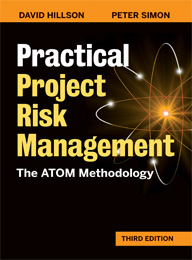 Written by practitioners for practitioners with little or no prior experience, the award-winning book Practical Project Risk Management: The ATOM Methodology by David Hillson and Peter Simon offers a realistic and proven scaleable approach to project risk management that really works. The third edition of this popular book was published in September 2020 (ISBN 978-1-52308-920-8), updated to include new guidance on how to run a risk workshop, the role of the risk facilitator, and applying the ATOM Methodology in programmes and portfolios.
This unique book is packed with tips and hints to demystify the risk process, and provides generic templates and guidelines to support real-world application.
For full details of the ATOM Methodology, visit the dedicated ATOM website
In this brief video, David introduces this book and explains why he wrote it.
- US-based customers can use the discount code ATOM30 when ordering from the publisher’s website to obtain 30% discount and free shipping.
- Non-US customers are eligible for 30% discount on e-books only.
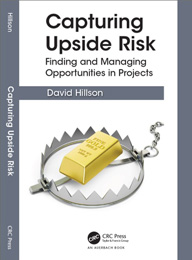 Capturing Upside Risk: Finding and managing opportunities in projects (ISBN 978-0815382515) was published by Taylor & Francis in June 2019.
This practical book gives new insights and detailed guidelines for identifying, assessing, and managing opportunities in projects through an integrated risk process. Proven tools and techniques are described, offering real advice on how you can find and capture opportunities in your project.
Risk management is more than “prevent and protect”, and this unique book explains in detail how to both create and protect value by managing opportunities and threats together.
In this brief video, David introduces this book and explains why he wrote it.
 The Risk Doctor’s Cures for Common Risk Ailments (ISBN 978-1-56726-459-3; Berrett-Koehler, 2014) offers tried-and-tested cures for the top ten risk management problems at both organisational and project levels.
Using a medical metaphor, David Hillson describes each “risk ailment” with diagnostic symptoms and prognosis, supported by real-world cases, then prescribes treatment options to recover from the ailment and prevent its recurrence. These common risk ailments include risk blindness, risk amnesia, risk muteness, risk obesity and risk depression.
The book supports self-diagnosis and effective treatment, and closes by describing how to stay risk-healthy once we’ve dealt with our risk ailments.
In this brief video, David introduces this book and explains why he wrote it.
 Exploiting Future Uncertainty (ISBN 978-1-4094-2341-6) was published by Gower in November 2010. This unique resource contains more than sixty focused briefings, each addressing a key part of the risk challenge.
Under five themes, David Hillson covers the links between better business and risk-taking, basic risk concepts, making risk management work in practice, people aspects, and managing risk in the wider world.
Each section is packed with clear practical advice from The Risk Doctor, with specific how-to tips and guidance.
 Risk appetite is a hot topic, driven both by corporate governance requirements and senior managers' need to make risk-based decisions. But despite the high level of interest, there is no consensus on what risk appetite is, how it should be expressed or measured, or how it can be practically used in business or projects.
In the third book to emerge from their successful partnership, A Short Guide to Risk Appetite (published in October 2012), David Hillson & Ruth Murray-Webster cut through the confusion to produce clear definitions and simple guidelines, helping us to answer the important question: "How much risk should we take?"
 The second edition of this unique and significant book by David Hillson and Ruth Murray-Webster was published by Gower Publishing in 2007 (ISBN 978-0-566-08798-1).
This book brings together leading-edge thinking on risk attitudes and emotional literacy to create a unique resource for those wishing to move beyond mere implementation of a risk process and towards a people-centred approach for risk management. However, no prior knowledge of emotional literacy is required by the reader, neither is knowledge of risk attitudes or psychology.
 This second book by Ruth Murray-Webster and David Hillson builds on Understanding and Managing Risk Attitude, and was published by Gower in May 2008 (ISBN 978-0-566-08787-5).
Based on the authors’ own experience and research, Managing Group Risk Attitude considers how groups of people make decisions that they perceive as risky and important.
A unique framework is developed and applied, providing a practical model using applied emotional literacy to manage risk attitude.
 This Risk Doctor e-book was published in August 2013 by Advanced Business Consulting, providing twelve of the most significant and important Risk Doctor Briefings in both English and Chinese. Each chapter addresses a key topic in managing risk, including principles, process and people aspects.
Discover the latest thinking in risk management and take your understanding and practice to the next level!
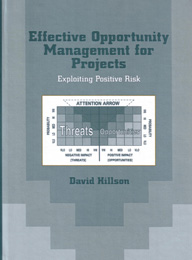 Effective Opportunity Management for Projects: Exploiting Positive Risk (ISBN 0-8247-4808-5) was the first book written specifically for people wanting to capture upside risk.
It makes the case for inclusion of opportunity management within the traditional risk process, and provides detailed descriptions of simple proven tools & techniques to make it work in practice.
Topics include a review of the risk definition debate, full details on how to address opportunities through the risk process, and discussion of implementation issues including risk culture and organisational maturity.
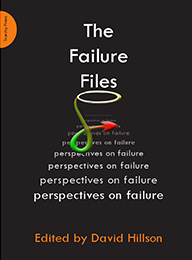 The Failure Files: Perspectives on Failure (ISBN 978-1-908009-30-2) was published by Triarchy Press at the end of March 2011.
Edited by David Hillson, this unique book addresses failure in a wide range of different aspects of society, including personal, education, business, entrepreneurship, projects, government, societal etc.
The book proposes a range of transformational responses for individuals, businesses and society, encouraging us to embrace failure and not to fear it. Discover from the experts how to fail well.